Tuesday, 2 September 2014

Audience 9 Nirvana _debates


Learning Objective:

To study Nirvana/Music industry with consideration given to the impact of signing a contract with an established record label.


Key Terms:

Synergy: This is the interaction and cooperation of two or more madia organisations in order to produce mutually beneficial outcomes. For example, the combination of the artist and the record company.

Convergance: This is the coming together of previously separated media industries. This is often the result of advances in technology wherby one devicecontains a range of different features. The mobile phone for example, allows the user to download and listen to music, view videos, tweet artists etc. All this can be done through one portable device.

MP3 Player: In the 1990's the arrival of the MP3 player allowed music to be distributed digitally across computer networks allowing the copying of CDs, the transferring oif files and downloading. The floodgates are open for the music industry.

Record label: These are companies that manufacture and distribute recorded music and promote the music.


Independent record label: This is a record label that operates without funding of and is not necessarily linked to a major record label.
Big Panda for example is an independent record label that is credited with the early releases of now established artists; Coldplay, Supergrass, Placebo before they moved on to bigger labels.
Independent labels do not have the advantage of the big labels, they do not handle their own distriubution and are more reliant on traditional ways of selling new music.
The demise of HMV in 2013 was a blow to many independent music producers as it accounted for 50% of CD sales.

Sell out: One who betrays a cause for personal advancement.


Task 1: Note these key terms.


Task 2:

Create a spider diagram which describes Grunge values. Orange books.
---------------------------------------------------------------------------------------------------

Nirvana biography

Geffen Records is an American record label, owned by Universal Music Group.
The label had chart success with well known acts Elton John, Cher, Aerosmith, Guns N Roses.

Sub Pop is a record label founded in 1986 in SeattleWashington. Sub Pop achieved fame in the late 1980s for first signing NirvanaSoundgardenMudhoney and many other bands from the Seattle alternative rock scene.

When Nirvana moved to Geffen Records, Sub Pop received royalties from sales of Nevermind that kept the label going for years afterwards. A stipulation was also implemented where selected future Nirvana studio LPs were required to carry the Sub Pop logo alongside Geffen's. After the mainstream success of Nirvana, many successful grunge bands had left Sub Pop for major record labels. 


Nirvana significant dates:

January 23, 1988 Nirvana records a 10-song demo with the “Godfather of Grunge,” legendary Seattle producer Jack Endino. Sub Pop co-honcho Jonathan Poneman hears the tape and offers to put out a Nirvana single. The band accepts.

June 1989 Bleach is released on Sub Pop. Nirvana embarks on a month-long U.S. tour.

September 25, 1990 Dave Grohl, former drummer for Washinton, D.C.’s Scream, joins Nirvana.

October 1990 Nirvana briefly tours England with L7.

Winter 1991 Nirvana signs with DGC Records.

August 1991 Nirvana opens for Sonic Youth on a European festival tour, which includes a landmark 
performance at the Reading Festival. The tour is documented in the film 1991: The Year Punk Broke.

September 24, 1991 Nevermind is released.

October 12, 1991 Nevermind is certified a gold album.

November 1991 The band starts a six-week European tour as Nirvanamania sweeps the United States. MTV airs “Smells Like Teen Spirit” video constantly; the song is hailed as an anthem for a generation.

January 11, 1992 Nevermind hits No. 1 on the Billboard 200 album chart.

January/February 1992 Nirvana tours Australia, Japan and Hawaii.

April 1992 Nirvana appears on the cover of Rolling Stone.

June/July 1992 Nirvana tours Europe.

December 15, 1992 Incesticide, a collection of B-sides and rarities, is released. It goes gold the following spring.

April 9, 1993 Nirvana plays a concert at San Francisco’s Cow Palace to raise awareness of and generate aid for rape survivors in Bosnia-Herzegovina. L7, the Breeders and Disposable Heroes of Hiphoprisy are also on the bill.

September 21, 1993 In Utero is released.

October 18, 1993 Nirvana starts a three-month tour of North America.

November 19, 1993 Nirvana tapes an all-acoustic show for “MTV Unplugged” at Sony Studios in New York. Cris and Curt Kirkwood of the Meat Puppets sit in on three Meat Puppets songs.

December 16, 1993 MTV airs Nirvana’s “Unplugged” show.

January 7, 1994 Nirvana plays the Seattle Arena. It will be the band’s last U.S. show.

February 6, 1994 Nirvana embarks on a tour of Europe.

April 8, 1994 Kurt Cobain is found dead of a self-inflicted shotgun wound.

November 1, 1994 Nirvana’s “MTV Unplugged” performance is released as MTV Unplugged in New York. Two tracks not aired on the MTV broadcast appear on the album.

October 1, 1996 The Nirvana live album, From the Muddy Banks of the Wishkah, is released, featuring performances from 1989 to 1994.

October 8, 2002 YOU KNOW YOU’RE RIGHT is released. This song was recorded in January 1994, and stands as the last song Kurt, Krist and Dave ever recorded together.

October 26, 2002 You Know You’re Right #1 on Billboard Modern Rock Chart and stays there for four consecutive weeks.

Task 3a: 

Consider these statements:

Y: You can't be in the entertainment industry too long without facing challenges and temptations to do things the easy way for a quick buck.

N: Nirvana wanted to go into a different direction musically. They wanted to make an album that did not sound like their first album.

Y: It's been said that Kurt walked into the record company and said he wants Nirvana to be the biggest band in the world.

N: Some say Kurt made the record sound more poppy so it would be more popular

Task 3b: 

Considering the values of the grunge genre, answer the following question: 

Did Nirvana sell out when they moved from Sub Pop to Geffen?


Further Reading:

Was Grunge the Last American Musical Revolution?

The year 1991 saw the releases of Nirvana’s Nevermind and Pearl Jam’s Ten. Those albums put Seattle on the musical map and flannel and army boots in every sullen American teen’s wardrobe. Adolescent angst was back in vogue and came soundtracked with a brand new anthem, Smells Like Teen Spirit.

However, the 20th anniversary of grunge is an uncomfortable reminder that music hasn’t given us anything “new” on such a grand scale since then. This generation still awaits its musical revolution.

We have, however, experienced one of recorded music’s greatest revolutions in regards to how music is delivered and marketed. The beginning of the 20th century saw sheet music and piano rolls. The phonograph forever changed music in that it now became about hearing actual performances from artists. Over the decades, radio, juke boxes, eight track and cassette tapes, and compact discs all played important roles in letting the music reach the masses.

However, none of those forms had the reach and impact of the Internet. In just over ten years, the way people access music has been permanently altered – for better or worse. A few clicks of the mouse or one’s mobile phone and any song imaginable is there for the listeners’ pleasure. However, much to the annoyance of the record companies, illegal downloads have ravaged their business while also giving consumers more control than ever before.

Perhaps it’s precisely because of the digital revolution that we have not seen a generation-defining genre since grunge. For one genre to so completely saturate the market perhaps requires a music industry with immense control over the market. 
Downloading can be said to have destroyed the hope for any new genre domination? 

Audience 8 Nirvana

Learning objective: To study Nirvana, Music industry with consideration given to audience targeting.


  • Key words: Targeting, Debates, Responses
To quote the BBC article - 20 Years of Nevermind; "The music is easily understandable - pop-rock with bite, grunge through critical categorisation but with enough melodic nous to stand tall. It speaks, even today, to the temporarily disaffected teen; but in a way that's inclusive, too, of anyone who just wishes to enjoy a great chorus, a cracking hook, and a mighty riff. Put simply, Nevermind nailed a formula".

http://www.bbc.co.uk/blogs/legacy/bbcmusic/2011/09/20_years_of_nevermind_why_nirv.html

Analysis of the Nevermind album cover.


In 1991 this album cover was unique as it showed a very bold message in the simplicity of the one image. Codes and conventions found in this album cover include:

- The baby is code for new life and a sense of freedom and innocence. The baby also represents simplicity and purity. The purity is also achieved as the baby is untouched, naked, it is a new born. It plays on the thought that the baby is free but not free from American consumerism.

- The money represents wealth, materialism, gambling and chances we take in life. The money is a dollar bill which makes the audience aware it is about American consumerism. The dollar is attached to a fishing hook like fishing bait this represents the consumer, chasing money.

- The open ocean represents freedom and the very blue water represents happiness and clarity. This could represent the happiness people feel when they have money and unknowingly are consumed by the music industry.

The 'Nevermind' album title graphics looks as though it too is underwater. 

The letters are very uneven and not the same in size. The title looks as though it is swimming in the ocean.
The 'Nirvana' band title is very simple and stretched out. 

The font looks very sophisticated and elegant, for example the 'R' is slightly looping giving it pride and elegance. We can gather from the title that Nirvana have a very clear political ideology on America and question if American consumerism has gone too far.
The black font used in both titles is code for simplicity and also sophistication.


------------------------------------------------------------------------------------------

How can audiences be categorised by different media industries?

Media industries categorise audiences in order to make them easier to target.
There are two main ways in which audiences are categorised by media industries:

Demographic profiling. This is the division of consumers into bands A to E according to, for example, their income, occupation, household size and maritial status.
A and B are the wealthiest members of society and are therefore assumed to have the most disposable income.
This information can be used to inform advertisers of the audience demographic.


Task 1: Discuss in pairs and take notes.
Why would media industries find demographic profiling useful?

Response to above:
Industries that need to sell advertising space, for example newspapers and magazines, find it essential to be able to give more specific information about their audience to advertisers.
Knowing the demographic profile of the audience allows the advertiser to target that audience effectively. A demographic profile gives relevant information about consumable income that will interest advertisers. 
The advertising industry itself uses demographic profiling to ensure that they fulfil the needs of consumers who are the target audience for products and services.


Psychometric profiling. This defines the audience by their values, attitudes and lifestyle and is seen to be more relevant in relation to today's consumers. This method was developed by Young and Rubicam, an American advertising agency. Audiences were split into categories according to their motivational needs.
There are clear links with Maslow in this model. We only need to be concerned with four of the categories.

  • Mainstreamers - Seek security, tend to be domestic, conformist, conventional. Favour value for money, family brands. Nearly always the largest group. Make up 40% of the population. They like tried and trusted brands and like to think that they belong to a group. They like value for money and are less likely to take risks.
  • Aspirers - Seek status, materialistic orientated to image and appearance, persona and fashion. Attractive packaging is more important than the contents. Typically younger people.
  • Reformers - Seek enlightenment, freedom of restrictions and personal growth. Social awareness and independent judgement. Anti materialistic but aware of good taste. Has attended higher education and selects products for quality.
  • Succeeders - Seek control, strong goals, confidence, work ethic. Supports stability. Brand choice based on self reward and quality. Typically higher management and professionals.


Task 2: 
Answer the following question with consideration given to the following:
  • Technical and audio codes.
  • Language and mode of address.
  • The positioning of the audience through camera shots and angles or through empathy with the artists.
Top tip: 
Include an opening paragraph. 
This will tell the examiner that you have understood the focus of the question. Targeting. 
You can give an overview understanding of audience in a media context and say why texts need to target audiences. Let the examiner know that you understand what mainstream audience is.

Here is the question:

To what extent do your texts (Nirvana and Miley Cyrus) target a mainstream audience? 

(Don't overlook the 'to what extent' part.)

Audience 7 Nirvana

Learning Objective:
To study Nirvana, Music industry with consideration given to Audiences.


  • Key words: Targeting, Debates, Responses
Introduction

Nirvana was an American rock band that was formed by singer/guitarist Kurt Cobain and bassist Krist Novoselic in Aberdeen, Washington in 1987. Nirvana went through a succession of drummers, the longest-lasting being Dave Grohl, who joined the band in 1990. Despite releasing only three full-length studio albums in their seven-year career, Nirvana has come to be regarded as one of the most influential and important rock bands of the modern era.
In the late 1980s Nirvana established itself as part of the Seattle grunge scene, releasing its first album Bleach for the independent record label Sub Pop in 1989. 
The band eventually came to develop a sound that relied on dynamic contrasts, often between quiet verses and loud, heavy choruses. 


In one of his first interviews, Cobain told Sounds journalist John Robb, "When I write a song the lyrics are the least important thing. I can go through two or three different subjects in a song and the title can mean absolutely nothing at all. Sometimes I try to make things harder for myself, just to try to make myself a bit more angry. I try out a few subconscious things I suppose, like conflicts with other people. Most of the lyrics on the Bleach album are about my life in Aberdeen."
In 1993, Cobain told Spin that on Bleach he "didn't give a flying f**k what the lyrics were about" and claimed that 80 percent of the lyrics were written the night before recording. He was often still working on the words on the drive to the recording studio. He explained: "It was like I'm pissed off. Don't know what about. Let's just scream negative lyrics, and as long as they're not sexist and don't get too embarrassing it'll be okay. I don't hold any of those lyrics dear to me." Nirvana biographer Michael Azerrad noted that, nevertheless, many of the songs on the album reflected Cobain and various incidents in his life. "Mr. Moustache" was inspired by Cobain's dislike of macho behavior, while "School" was a critique of the Seattle music scene, particularly Sub Pop.

Uses & Gratifications Theory focuses not on the product but on what people do with the media. 
This theory suggests that audience members actively seek out media products to satisfy their needs. 
It also suggests that, since the audience are being active, they pick and choose the messages and ideas that suit them from a media product and ignore the rest. These motivations can be linked to Maslow's hierarchy of needs.

Task 1: 
Discuss in pairs and make bullet point notes under the heading; Nirvana - Target audience.
What was the primary target audience for Nirvana? What things motivate or interest this audience?
Did Kurt Cobain understand the motivations of Nirvana's Primary target audience?
How did he appeal to them?


After signing to major label DGC Records, Nirvana found unexpected success with "Smells Like Teen Spirit", the first single from the band's second album Nevermind (1991). Nirvana's sudden success widely popularized alternative rock as a whole, and the band's frontman Cobain found himself referred to in the media as the "spokesman of a generation", with Nirvana being considered the "flagship band" of Generation X. 


Genre - Signifiers, Conventions, Iconography

Music videos have genre characteristics.

Certain features are expected out of a video depending on the genre of the music, for example girl bands/artists are expected to have dancers and close ups of the singers, whilst a Indi band are expected to have performance shots of the band and be cut to a fast beat.

Theorists in Semiology tell us that the meaning a code communicates is always culturally determined.  This means that we learn codes and symbols as we grow up according to our society and culture.

Nirvana: Genre Metal/Punk/Pop. 

Musical characteristics present within Nirvana:

• Singing style (elements of shouting and screaming)

•Instruments and effects used

•Simple musical structures (verse chorus verse, mostly containing a bridge)

•Some elements but not as purist as punk on Anti-establishment ideology

•Smashing instruments. Seemingly sloppy musicianship. Use of bar chords.

Flannel Shirt

Importance to industry (helping in creating a subculture) Grunge Fashion

•Clothing commonly worn by grunge musicians and fans consisted of clothes that was purchased from or looked like they were from charity shops

•Most common was checked/flannel shirts

•A look that appeared un-kept (ripped jeans, baggy T-shirts, longish hair, anti superficial)

•Grunge fashion was very anti “Flash/show off”


Generation X, commonly abbreviated to Gen X, is the generation born after the Western Post–World War II baby boom. Demographers, historians, and commentators use beginning birth dates ranging from the early 1960s to the early 1980s.
In 2011 "The Generation X Report" (based on annual surveys used in the Longitudinal Study of today's adults) found Gen Xers, defined in the report as people born between 1961 and 1981, to be highly educated, active, balanced, happy and family oriented. The study contradicted the materialistic, slacker, disenfranchised stereotype associated with youth in the 1970 and 1980s.

Assessment for Learning.
(Quick) task 2: Spider diagram, orange books.
How do Nirvana's songs and videos reflect the codes and conventions of the grunge genre?
___________________________________________________________________
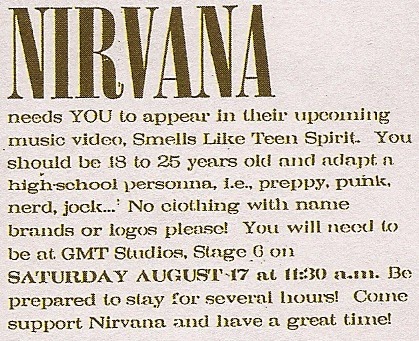
Casting notice for the Nirvana video 'Smells Like Teen Spirit'.

In response, Nirvana's third studio album, In Utero (1993), featured an abrasive, less-mainstream sound and challenged the group's audience. The album did not match the sales figures of Nevermind but was still a commercial success and critically acclaimed.
Nirvana's brief run ended following the death of Kurt Cobain in 1994, but various posthumous releases have been issued since, overseen by Novoselic, Grohl, and Cobain's widow Courtney Love. Since its debut, the band has sold over 25 million records in the United States alone, and over 75 million records worldwide, making them one of the best-selling bands of all time. Nirvana was inducted into the Rock and Roll Hall of Fame in 2014, in its first year of eligibility.

[Nirvana literally means "blown out", as in a candle. It is most commonly associated with Buddhism. In Indian religions, the attainment of nirvana is liberation from the repeating cycle of birth, life and death (reincarnation).
In the Buddhist context nirvana refers to the stillness of mind after the fires of desire, aversion, and delusion have been finally extinguished].

Nirvana industry issues

Digital technology has been hugely important for three piece Grunge band Nirvana. When their album 'Nevermind' released in 1991 (Geffen Records), people did not have access to the modern technology that we have today such as the internet. This means that the band had to rely on live performances and 'word of mouth' to spread their popularity and ideology.


The main form of digital technology that Nirvana used when their album was released was the live TV performances such as performances on Jonathan Ross and Top of the Pops. For these live performances they pulled 'PR stunts' as to make a huge impact on the audience and therefore become more popular via word of mouth. A example of this is their performance on Jonathan Ross where they were meant to play their song "Lithium", their most radio friendly song but instead they played they played "Territorial Pissing" their most radio unfriendly song. This stunt was sure to drum up a lot of attention and portrays the grunge ideology of rebellion and anti-establishment.


Now in modern times we have access to many more forms of digital technology that were not available in the 1990's, such as youtube and iTunes
These 'on demand' services mean that the target audience can view and listen to Nirvana's songs/ music videos where ever and when ever they want. This contrasts to the 1990' where the music was only available on CD, radio and Tv channels (MTV). Itunes allows new generations to find older music because the technology is quick, simple and could be referred to as 'impulse purchases' . The fact that the music is readily available to the masses 20 years after the release ensures the longevity of the band.


------------------------------------------------------------------------------------------------

(Quick) Task 3: 
What are the advantages of digital technologies for the music Industry?
Bullet points, orange books.

Response to the above question:

A band that didn’t have access to digital marketing during their career were ‘grunge’/ rock three-piece Nirvana. 
For their 1991 album ‘Nevermind’ they were totally reliant upon marketing via their major record label Geffen. 
Coverage from music press such as ‘NME’ and ‘Rolling Stone’ magazines helped promote the band's profile but ‘word of mouth’ was essential in spreading the message about the bands work pre-Internet as well as TV appearances and live touring. 
Due to this it took the band 5 months to get to number 1 on the Billboard 200 charts, whereas Miley Cyrus 'Bangerz' album went straight to the top of the charts in their first week proving the effective use of digital technology in the music industry in today's modern marketplace. 

Digital technology was not available during the early 90's but their popularity is now widely promoted via ITunes and other online sites such as Facebook as a form of nostalgia for both those that enjoyed their music at the time and new fans. The suicide of lead vocal Kurt Cobain and the rise in sales post-death poses the statement that ‘artists make more money/ get more recognition once they’re dead’. This can be proven due to release of albums such as ‘Nirvana’s Greatest Hits’ released via online stores for the 20th Anniversary of Cobain’s death, promoting their work further with the use of digital technology. 


---------------------------------------------------------------------------------------------

Nirvana also have a large number of Fan sites all over the Internet and social networking sites and this also ensures that the longevity of the band. The relative new appearance of social networking may not be as important for Nirvana as it is to Lady Gaga, but it still has a huge impact. It means that the fans of Nirvana, both past and present, can meet like minded people virtually and engage in social interaction with them and this means that the band/album stay as a topic of conversation 20 years after album has been released. 

_____________________________________________________________________________

(Quick) Task 4:
Write a short essay answering the question
How did Nirvana appeal to its audience, compare with how Miley Cyrus appeals to her audience.

Give consideration to the following:
Authenticity and how they attempt to involve the audience.

A response to the above task (the nirvana part).


Nirvana had to rely upon upon their major record label Geffen to gain them mainstream popularity in the 1990's as the Internet was in its infancy. Their 1991 release 'Nevermind' was released by Geffen at a time when to achieve widespread success in the music industry it was essential to be signed to a global label as they had the marketing and distribution capabilities to promote artists. At this time critical acclaim, through reviews, and 'word of mouth' enabled artists to become popular and established on the independent circuit, but this restricted worldwide success due to lack of revenue - this is why Nirvana chose to ditch their independent label Sub Pop and sign to the major label Geffen

Their use of a strong visual rebellious iconography; long-hair, ripped jeans and punk rock attitude had already created a hardcore audience which had allowed them to successfully market themselves to not only metal fans but also more alternative genres. This attitude can be clearly seen in the 'Smells Like Teen Spirit' music video. In the opening shot we instantly see the 'Converse All Star' baseball shoe a typical clothing signifier of teen rebellion. The videos mise-en-scene of a high school basketball court with teenagers 'moshing' in slow-motion was also highly evocative of Nirvana's cultural ideology and potential audience appeal.

Nirvana's DIY, punk attitude was already well-established from their time at Sub Pop, but maintaining this with the move to Geffen increased their marketing potential as they hadn't 'sold out' to their hardcore fans. On the UK promotional tour for 'Nevermind' Kurt Cobain, and the rest of the band, maintained their authentic attitude and image on several TV shows such as Jonathan Ross and Top Of The Pops. On the Jonathan Ross show in 1991 they were expected to play their new single 'In Bloom' but instead chose to play one of their heaviest metal genre songs 'Territorial Pissings'. This created  a buzz around them and people wanted to see them live and this also increased the sales of their album'Nevermind'.  This would have been viewed as a highly effective marketing strategy in the early 90's before the progression to internet marketing as their popularity was increasing through reviews and 'word of mouth'. 

However, since the demise of Cobain and Nirvana the Internet has now enabled their legacy to continue through iTunes and youtube and their music can still be marketed at a young rebellious audience. The ability to target audiences throughiTunes with links to other artists has allowed marketing approaches to successfully reach appropriate audiences without the added costs of promotional and live touring. The Internet has also allowed new audiences to discover Nirvana and buy their album 'Nevermind' as witnessed for the 20th Anniversary re-release via iTunes. This has now allowed the album to achieve over 26 million sales worldwide since its release in 1991.