Thursday, 13 November 2014

Audience assessment question

The exam question on audiences will require you to apply your knowledge to the texts we have studied.
  • Luther
  • Life on Mars
  • Common
In what ways do different audiences respond differently to the same media text?  
Firstly, look at what they question is asking you.
1)  Identify ways audiences can respond - take a preferred reading, negotiated or oppositional could be one example of responses.
2)  Then identify different audiences- gender differences, age, ethnic group, religion sexuality etc.
3)  Then, using the ways audiences can respond choose an audience group and show how and why they might respond differently. Eg. Older people that remember the 70's.
4)  Then select an appropriate text and example. Eg. Life on Mars 
     Older people represented as sexist, racist and with backward police approaches where fitting a suspect up is fine as long as they deserve it.
5)  Discuss responses your audience group may take e.g. They might take a preferred reading of a text as they fit the lifestyle and age group represented so can relate to the text (music, clothes, cars) but could equally reject the stereotypes and be very offended that 70's people are portrayed in such a negative way, as they themselves feel that the show is set in a time of change with institutions such as the police force introducing moves to introduce openness and the integration of more prominent roles for women. 

6)      Repeat with another audience group- a gender, age group etc and show their difference responses to the same text.

****************************************************************


Nike Advert (Wayne Rooney)


National Identity/ Patriotism: Audiences are positioned to take a preferred response to the visual codes in this advert by perceiving football as being ‘as important as religion and British culture’ (deconstruct the image to illustrate this- e.g. crucifix-like icon of Rooney). 

Religious Beliefs: People who consider themselves to be religious may be positioned to take an oppositional response to the text as they may feel insulted that Rooney has been compared, through use of symbolism, to Jesus Christ.  You can argue that Nike as a company may encourage this response from a segment of the audience as the controversy will bring more attention to the advert, thus helping them receive more publicity and PR and promoting their product further (especially as Adidas was the key sports brand sponsor of the World Cup 2010).

Celebrity endorsement- football fans may be attracted to this advert as he is endorsing the Nike product, explain how they will consume some of the ideologies and how they may agree with them.

Patriotic audiences may be attracted to this product- explain what is being presented to the audience and how this may agree with their personal social values- this reinforces their beliefs

The text positions audiences to take different responses to the advert and controversy - explain who would have these responses and what they would be.

**************************************************************
Suggested essay structure:

Introduction:
· Outline that the primary aim of 
a media text's is to attract audiences so that they keep getting funding for their product or meet target audiences needs and get high viewing figures.

· Explain that audience are attracted to media products for many different reasons and give some examples of what they may be...... (e.g. Narrative, Characters, Personal Identity, Information, Loyalty, Social Identity etc)

· Explain which texts your answer will approach

Main Body:
Give 2 textual examples.

· Remember you need to choose texts to discuss that attract a RANGE of different audiences so it needs to be a text that will be popular with different audiences

You will need to explain:

The genre of the text

Reason for attracting different audiences

Examples from the actual text that may attract different audiences for different reasons- explain
these reasons in detail

Viewing habits- if a programme is on at prime time 6pm-9pm then it is more likely a more diverse
audience will be attracted to the programme than after the watershed.

With reference to film, a classification may affect who views it (e.g. if the film is an 18 it discounts
anyone below this age barrier)

Compare and contrast different reasons for consuming these texts and what may be communicated to the audience through them


Summary:
· Sum up points you have made briefly about your chosen texts
· Give brief reasons for diverse and different audiences
· Sum up what may attract different audiences to the same text



Thursday, 6 November 2014

Research Investigation Surgery

Each candidate will attend a one to one session to consider research investigations.

Monday 10/11/14 Period 4: Adam Caton. Dylan Ditchfield.
Monday 10/11/14 Period 6: Jordan Hynes. Shaun Kelly.
Tuesday 11/11/14 Period 1: Michael O'Driscoll. Joshua Roberts.
Thursday 13/11/14 Period 3: Paul Scarratt. Daniel Tremarco.
 Friday 14/11/14 Period 5: Jack Moran. Daniel Tyrer.

E-mail mr Ealey with an up to date version of your R. I. The day before.
Be prompt.
Research Investigations must be complete and marked before Christmas and need to inform your production work.

Wednesday, 5 November 2014

Iconography an introduction


In Media Studies we see iconography as part of genre, and particularly film genre. Students need to know the term and how it is used. It is quite a complex concept, that informs image analysis and the deconstruction of genre. Iconography originates from the study of art.


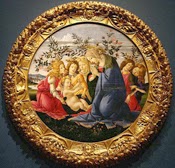
 In Europe in the15th & 16th centuries artists creating work of a Christian nature would look up reference books to check the colours, composition, hand gestures, poses and facial expressions that past masters traditionally used, because they conveyed the most significant meaning to the ordinary person. These meaningful images came to be known as iconic, and their use is iconography.


For example most paintings of the Madonna, including modern ones, show her in a robe of deep blue. The Virgin wears a blue robe, the colour symbolic of heaven and a reminder of the Virgin’s role as Queen of Heaven. This colour came to be an icon for her role as a spiritual mother who has dignity and religious importance. The blue robe is part of the iconography of this form of art throughout the centuries.
Right – Madonna and Child by Donielle Boal fineartamerica.com/featured/madonna-and-child…
Left – Madonna and Five Angels by Botticelli

Definition


Steve Campsall’s definition of iconography is useful. (Steve Campsall – Media – GCSE Film Analysis Guide (3) – SJC)
Iconography is an important aspect of genre. We expect to see certain objects on screen when we see a particular genre, for example, in a Western, dusty lonely roads, saloon bars, cowboy hats and horses, jails, sheriffs badges, guns, etc.. 
In a modern horror film, we expect young girls, ‘normal’ objects, use of dark and light, etc. These ‘genre indicators’ are called the iconography of the mise-en-scene or genre.’

So iconography can be defined as those particular signs we associate with particular genres.
Film producers use images that belong to the iconography of the genre to excite audience expectations, and to show that the film is within a certain genre. If you wanted to see a comfortable rom-com you would not go and see Prom Night, but if you wanted to be scared then this should do the trick.
Another way of putting it is to say genre can be identified by the look of the images in the text – this is the iconography, or the signs, that are associated with a genre. Iconography includes a wide range of ‘signs
To become part of the iconography of a genre a pattern of visual signs remain constant in that genre over a period of time. Some of the things that make up genre iconography include:

Costume


Cowboys wear ten gallon hats;
characters in costume dramas wear wigs and historic costumes;
tough guys in thrillers wear black leather jackets;
in high school movies everyone wears tight T shirts, sneakers and some wear hoodies.

Settings

Thrillers are set in challenging urban neighbourhoods found in big cities such as LA or New York. Horror movies since Halloween (1978) tend to be set in typically quiet suburban settings. Sci-fi films inhabit futuristic cities with flying cars, adverts in the sky (e.g. Bladerunner), and high tech interiors.

Stars

Some film stars can be an important part of a film’s iconography, and carry their own iconographic meanings.
This was perhaps more evident in the past where stars like John Wayne are always associated with Westerns. Modern stars such as Clint Eastwood carry the iconographic meaning of theloner against the worldCampsall (ibid) says:

stars create expectations of character and action, genre, and powerful iconic representations of such as masculinity and femininity.’


Props


These are the movable objects that are so important to many movies.
Gangster films must have guns.
Classic gangster films have a certain form of gun – the violin case machine gun.
Characters in Westerns carry classic Colt revolvers, or the Winchester rifle.
Police and thrillers use expensive multi-shot shiny hand guns.
Cars are important for what they signify in a film.
Large American gas guzzling V8 saloons can signify the freedom of the open road, as well as escape, and refuge.
Cars can be an extension of a character’s personality as well as a device to create excitement and thrills.

Signs and Signifiers

When we look at the iconography of a film we are looking at the way certain images conveylayers of meaning – in other words there is much more meaning than is at first apparent. The science of how meaning is created by signs is called semiology, from the Greek work semeion meaning sign. Semiology explores the way signs and codes are used in texts.

So what is Semiotics?

Semiotics is the study of signs, symbols and sign systems, and their meanings. Semiotics is a way of explaining how we make meaning in a text. But meaning is not just what you read or see.
 Semiotics tells us that all meaning is ‘encoded’ in objects and images that create meaning.

The word ‘love’ can be seen as the sign of an idea that encodes many different meanings. As you read the word you interpret it’s meaning according to who you are, your education and yourcultural values, and the context that the word is in. We learn to decode this meaning as we grow up and are educated. Our understanding of the meaning of the word love depends, to a certain extent, on what other people over the centuries have already decided it means. 
 Activity
1. How would you interpret the word love in this picture?
 2. Create a sign of the meaning of love without the word love in it.

Semiotics

In semiotics, a sign is the smallest amount of meaning we can decode, and which also contributes to overall meaning.
For example, in the way you dress each day you encode an ensemble of signs to create a meaning. This might be a ‘designer’ meaning suggesting wealth and power, or a street-cred meaning suggesting an anti establishment attitude or just person taste.
 If all this sounds very complicated look at it this way – a sign has more than one meaning especially when it is in a media text such as a film.

So meaning works in two distinct ways.
1. A sign has a basic meaning literal meaning – for example – a poppy is a flower. This is called its denotation.
2. A sign can also have another second meaning related to something completely different, which is often related to its context. This is called its connotation.
If you put the poppy in a field with another sign which has many meanings such as a cross, you have an overall image with multiple meanings. 
In the above example: the poppy is a sign which when added to the sign of a cross connotates thecultural code of remembrance for those killed in war, particularly the first World War.

In November in the UK the red poppy on its own has connotations. Many people wear a poppy as a sign to connotate that they share in the grief for those fallen in war. In another culture the poppy sign could be interpreted quite differently.
We can say that the poppy is a flower but it has a connotation which is the extra meaning brought to the image through the cultural values of the reader. 
In semiotics, a code is any group of signs that seem to go together to create an overall unit of meaning. So the poppy and the cross are a code. See:http://www.greatwar.co.uk/article/remembrance-poppy.htm

Semiotics Theory

In semiotics there are three basic types of sign and code:
1. Iconic signs and codes are created to represent the thing itself so that an image of a mafia gangster looks like, or signifies, a mafia gangster.
Iconic codes also work to create extra meaning so that when we see an image of a gangster we associate it with meanings of lawlessness, of a person involved in drug dealing, a dangerous person who will kill, and who our culture identifies as a definite ‘baddie’. 
2. Indexical signs are different. They work by indirectly suggesting a meaning by prodding our existing knowledge and understanding.

For example a heart shape signifies romance suggesting love between two people. The heart shape has no meaning in itself, except to symbolise love. Indexical codes are a type of media shorthand which can be seen everywhere in advertising and in the way signs are used to give us information such as road signs.
Task 1:
Think of all the memories, ideas, feelings, and cultural references that the indexical sign of a lighted Christmas tree invokes.


Write a list now – write about the personal significances the Christmas tree has for you, and write about the wider cultural significances such as peace, family, togetherness, presents, and spiritual renewal.
 You can add your musical signifiers too, which may not be just Christmas songs and carols.
 3. Symbolic codes act as signifiers of meaning which are not remotely the same as what they actually look like (what they denote).


Often in a film the bad guy wears all black, and this is to symbolise evil.
An all black outfit may suggest ‘cool’ too. Both meanings have nothing intrinsically to do with the clothes themselves.
In comedy sketches a burglar may wear a striped shirt, a mask, and carry a bag marked swag – we all know that this costume symbolises a comic burglar – it works as a short hand for the audience– but why the striped shirt symbolises a burglar is an interesting question.
Theorists in Semiology tell us that the meaning a code communicates is always culturally determined.  This means that we learn codes and symbols as we grow up according to our society and culture.
Well known buildings can connotate much more than the image of a large building.

Look at this picture of Buckingham Palace. What is the connotation about England? It suggests that England has a monarch, is a stable country with a well respected ruling king or Queen, who comes from a tradition of established monarchy but is not dominated by the monarch – compare this quite discrete palace to any one of Saddam Hussein’s many enormous palaces.
Somehow this picture represents aspects of Great Britain that are attractive to people from abroad. It also connotes patriotism and pride to many English people. Many well known buildings work hard to express a variety of connotations – can you think of any other famous buildings that symbolise more than just the use of building.


This seems to have come along way from film iconography but, if you think about it, it is all very similar. Think of any film that you enjoyed – the characters, the costumes, the settings, the objects, the way the film is shot, the use of lighting, the selection of shots – big close ups, or a lot of of wide shots, the way the film is edited, the use of music ( where would the film Breakfast at Tiffanys be without the song Moon River) all these things go towards the iconography of the film.
It’s really fun working out how all the signs and symbols work to create a rich cinematic experience.

Tuesday, 4 November 2014

Marxism


Representation
The role of media a Marxist perspective.
You will watch a clip (London Olympics) and analyse it with consideration given to the representation of Britain (National identity).

  • Key words: False consciousness. cultural hegemony, false needs.
Capitalism. A definition:

An economic and political system in which a country's trade and industry are controlled by private owners for profit, rather than by a state run by the people.


Marxism. A definition:


The political and economic philosophy of Karl Marx and Friedrich Engels in which the concept of class struggle plays a central role in understanding society's allegedly inevitable development from bourgeois oppression under capitalism to a socialist and ultimately classless society.


While Karl Marx only knew the press before it was a mass medium, it is still possible to analyse modern media according to his ideas  
even though Marxism is widely thought to have failed as a guide to social change.
The media as an industry conforms to a general capitalist type through its factors of production. 

These are likely to be in the monopolistic ownership of the capital owning class and be organised to serve the interest of that class. This is done through the exploitation of workers (ignoring the true value of labour) and consumers (making excess profits).


Media works ideologically by disseminating the ideas and world views of the ruling class, denying access to alternative ideas that might lead to change or to a growing consciousness of the working classes with regards to its interests.


The main contribution of the media is to stimulate and then satisfy false needs. This leads to the assimilation of groups who have no real material interest in common into a 'one dimensional' society.


False consciousness


1.
Marxist theory that people are unable to see things, especially 
exploitation, oppression, and social relations, as they really are; the 
inability of the human mind to develop a sophisticated awareness of how it is developed and shaped by circumstances.
2.
Any belief or view that prevents a person from being able to understand 
the true nature of situation.

Marxist theory of media:

  • Mass media is owned by the bourgeois class
  • Media is operated in their interest
  • Media promotes working class false consciousness
  • Media access denied to political opposition.
Cultural hegemony
IMarxist philosophy, the term Cultural hegemony describes the domination of a culturally diverse society by the ruling class, who manipulate the culture of that society — the beliefsexplanationsperceptionsvalues, and mores— so that their ruling-class worldview becomes the worldview that is imposed and accepted as the cultural norm; as the universally valid dominant ideology that justifies the social, political, and economic status quo as natural, inevitable, perpetual and beneficial for everyone, rather than as artificial social constructs that benefit only the ruling class.

Task 1:

Bearing in mind the Marxist theory of media;


Watch the video clip below and analyse with consideration given to the representation of Britain (National Identity).

List the visual codes, Audio codes and geographical markers.
Write 200 words describing what the opening ceremony is saying about being British. What would other nationalities think about this?
Remember: Denotation - Connotation - Signification.

Intertextuality definition:

Relating to or deriving meaning from the interdependent ways in which texts stand in relation to each other.


Some additional clips for comparison:

BBC 1 News


Fox News

Wednesday, 22 October 2014

Representation and Theorists

Representation

All media messages are ‘constructed.’ We should not think of media texts (newspaper articles, TV shows, comic books to name just a few) as “natural” things. Media texts are built just as surely as buildings and highways are built. The building materials involved vary from one kind of text to another. In a magazine, for example, there are words in different sizes and typefonts, photographs, colors, layout and page location. Selection.


TV and movies have hundreds of building blocks - from camera angles and lighting to music and sound effects. What this means is that whether we are watching the nightly news or passing a billboard on the street, the media message we experience was written by someone (or probably several people), pictures were taken and a creative designer put it all together. But this is more than a physical process. What happens is that whatever is “constructed” by just a few people then becomes “normalized” for the rest of us; like the air we breathe, it gets taken for granted and usually goes unquestioned. But as the audience, we don't get to see or hear the words, pictures or arrangements that were rejected. We only see, hear or read what was accepted! 


This is called omission.


The success of media texts depends upon their apparent naturalness; we turn off a production that looks “fake.” The truth is, it’s all fake – even the news! That doesn’t mean we can’t still enjoy a movie, watch TV or listen to music. The goal of this question is not to make us cynical but simply to expose the complexities of media constructions and thus create the critical distance we need to be able to ask other important questions. 


Media have embedded values and points of view. Media, because they are constructed, carry a subtext of who and what is important -- at least to the person or persons creating the construction. Media are also storytellers (even commercials tell a quick and simple story) and stories require characters and settings and a plot that has a beginning, a middle and an end. The choice of a character's age, gender or race mixed in with the lifestyles, attitudes and behaviors that are portrayed, the selection of a setting (urban? rural? affluent? poor?), and the actions and re-actions in the plot are just some of the ways that values become “embedded” in a TV show, a movie or an ad.


It is important to learn how to “read” all kinds of media messages in order to discover the points of view that are embedded in them and how to assess them as part of the text rather than merely accepting them as “natural.” Only then can we judge whether to accept or reject a message. Being 
able to recognize and name missing perspectives is also a critical skill as we negotiate our way each day through our mediated environment. 


For representations to be meaningful to audiences
There needs to be...
A recognition of people
A recognition of situations

All representations have ideology behind them

Levi Strauss

Task 1: What message is this text trying to send about dominant British ideology?
200 words. Orange books.


Paradigms (patterns) are encoded into texts
Paradigms are left out of texts
to create a preferred representation

The term cultural hegemony describes the domination of a culturally diverse society by the ruling class, who manipulate the culture of that society — the beliefsexplanationsperceptions and values — so that their ruling-class worldview becomes the worldview that is imposed and accepted as the cultural norm

Examples of hegemonic values
The police are always right
It is important to be slim
A credit card is a desirable status symbol
Mass immigration is undesirable
The poor are lazy and deserve their hardship
Men work, women look after kids
It is important to wear fashionable clothes


Task 2: What is message is this text trying to send? Consider hegemony.


_____________________________________________________________

What sense of the world is it making?
Is it typical or deviant?
Who is it speaking to? For whom?
How do we respond?

Richard Dyer

Task 3: Answer the above questions while deconstructing this text.


___________________________________________________________

Magazines, ads, texts are encoded (see Stuart Hall)
to represent an aspirational lifestyle

Identities are not given but are
constructed and negotiated

Gauntlett

Compare the constructed identities in these two texts:


__________________________________________________________

Capitalist classes protect their economic interests

Groups in power exercise a cultural influence rather than a forceful one.

Consensual power: 
Convincing the working classes that their interests were the same as those of capitalists


The desire for valued rewards or the fear of having them withheld that ensures the obedience of those under power

Representations are encoded into mass media

This reinforces dominant ideology

Marx

_____________________________________________________

Further reading

Tuesday, 7 October 2014

Quick Rep of Class task

        Consider:
Costume, language, setting


Consider the following points when watching the clip:


  •        Can I identify what class the characters/people are from? How?
  •       Are people from different  classes shown as having different interests,          personalities,  attitudes or behaviours? If so, how?
  •       Is their class represented as being the most important thing in their life?
  •       Are people from particular classes portrayed as being better, more powerful, than others?
  •       Are people from particular classes portrayed as being abnormal /weaker/ more pathetic than  others? 
  •      How do other characters in the clip treat the characters from different classes?
  •      What is the message the clip is trying to portray about class?
  • Watch this clip and comment on the representation of class.
  • https://www.youtube.com/watch?v=PLB4IJk5ZFI

Sunday, 5 October 2014

Focus Groups and questions for research. Layout.

Keywords: questionnaires, focus groups, discursive.

You should continue to focus on content for primary research; questionnaires, focus groups and surveys.

Stay focused on the title of your investigation when you are considering questions. Think about what the possible answers might be and how they can contribute to your arguments 
This is a discursive essay.

The research needs to be carried out this week. 
E-mail participants in advance if they are needed for a focus group or survey.
Indicate results as percentages (rather than saying 7 out of 12).

Below are some more exemples of how to lay out documents for participants:


Again, here is the WJEC criteria:

Research Investigation 

• Research investigations should be undertaken individually and negotiated between student
and teacher.
• Titles need to be focused (can be based on one, or more usually, two texts) – to tailor titles
to the ability and interests of the candidates as well as helping them stay within the 1400-
1800 word count.
• Include the concept being investigated (genre, narrative or representation) in the title
• Students need to be taught research skills to equip them to work independently.
• Students need to undertake a range of research including primary research (such as textual
analysis, content analysis, questionnaires, focus groups etc) and secondary research
(books, magazines, internet relevant to the investigation).
• A 'bibliography' or list of sources referred to must be included. Clarity and accuracy is more
important than the style of referencing.
• The investigation should be presented as a discursive essay – with or without illustrations.