Monday, 12 January 2015

16 Conventions of CD covers


Learning objective: To deconstruct the codes and conventions of CD covers

Key words: Genre, target audience, conventions, fonts.


Textual analysis:
‘Investigate how genre conventions are used in the CD cover ROCKFERRY by Duffy’

This is for analysis of :

The CD cover contains many recognized codes and conventions.

Main image
A large black and white image of the star Duffy dominates the text set against an out of focus background which includes the carriages of an old fashioned train. 
The photograph has been taken with a shallow depth of field. The image is typical of the soul genre of the Sixties and has connotations of that iconic period in popular music which includes the promotional images of The Beatles and models photographed by David Bailey. 

Duffy looks as though she doesn't want to let go of her youth, is she afraid of the journey she is about to take possibly to adulthood which would be identified with by a teenage audience.

The cover reminds us of the sixties British white soul singer Dusty Springfield: (Fig 2).


(Fig 2)

Duffy is looking down and looks a little sad about the journey she is about to take.
The photo is taken at eye level and is a naturally lit mid-shot taken in a realistic setting.
We can see from Duffy's body language, holding on to her coat that she may be apprehensive.

The symbolic codes of dress which include a bold black and white coat and bleached blonde hair. Again this reminds us of the Sixties and iconic singers like Dusty Springfield who is reknowned as one of the greatest white, British, female soul genre singers. Duffy's style of singing has been called Blue eyed soul.

The presence of the train could suggest the star is about to take a journey. Rockferry is a small working class town on the Wirral and a well known narrative of 'rags to riches' is being constructed. 
There are connotations of the English North /South divide which exists today as it did in the Sixties when the Beatles traveled from Liverpool to London in the film A Hard Days Night.

Graphics:
The title of the album is in capitals and the serif font STENCIL has been used.
Stencils are used by rail companies to identify their cargo, so the lettering has connotations of train travel.
Above the main image is the signature of the artist. It can be described as feminine This will appeal to the target audience who may feel they are buying something unique or collectible, like the autograph of Duffy the celebrity personalising the CD for fans.

In conclusion, the codes and conventions used on the CD are typical of the British soul genre which was reborn through artists like Duffy in the mid noughties.
________________________________________________________________

Task1:
Write the codes and conventions of CD covers into your Orange books.

Task 2:
Using the template provided, design a cover for a new CD promoting Nirvana's greatest hits to a new audience of young people aged 15 - 25.


Peer Assessment.

Use the handouts provided to assess the work of your peer.
Award 20 marks for each of the success criteria indicated above giving a final total out of 100.
The assessment focus for this task is: CD cover - codes and conventions


Year 13 written tasks success criteria:
Knowledge of the concept of audience/representation/narrative
Awareness of relevant theories
Uses examples to draw on relevant issues
Use of media terminology/key words
Quality of written communication


Sunday, 11 January 2015

16 Conventions of DVD covers (Assessment HT 1)

Learning Objective: 
To apply the conventions of DVD covers to a mock up DVD cover of the sequel to a film you are familiar with.

Key words: 
Main title, main image, hierarchy, spine, cast, age certificate, blurb, synopsis, reviews, awards, running time, institutional logo, lettering, action line, handwritten.


  • Tagline – draws the audience’s attention sometimes by asking them a question.
  • Iconography – relevant to the genre or images of famous actors, or even places – because the  audience may recognise them from other films they are familiar with.


  • Industry reviews – gives the film critical acclaim, often accompanied by stars out of five.
  • Sequel – audiences may have seen the first one and will find a sequel appealing.
  • Blurb or synopsis on the back of the DVD cover – wording is sensationalised mentioning actors' names and giving information about the narrative.  Sometimes asking asks questions to the audience to create enigmas making them want to find out more.
  • Bonus features – the audience is getting inside information about the film, the actors, crew. Gives the text a personal feel.
  • Awards – gives the film recognition to the audience. Audiences want to watch successful films.
  • The production company – audiences recognise them from previous films and give them an indication of the style of the film.
  • Director – audiences might recognise the name from other films they have made.
  • Film classification – necessary organisational issue.
  • Screen grabs – gives the audience an insight into the film.


  • Task 1:
    Discuss and list the conventions evident on this annotated DVD cover (Wizards). Ignore the typos. Orange books.

    Task 2: Take notes from this DVD cover presentation. Orange books.

    Assessment. Task 3: 
    Using the template provided, design a mock up of a DVD cover for the sequel to a film you are familiar with. If you are investigating film for your research investigation then this should provide you with your title. Make notes on the back of the handout rather than annotating your design.
    This is not an Art exam so just indicate any colours along with the connotations for that colour.


    Peer Assessment.

    Use the handouts provided to assess the work of your peer.
    Award 20 marks for each of the success criteria indicated above giving a final total out of 100.
    The assessment focus for this task is: DVD cover - codes and conventions

    Year 13 written tasks success criteria:
    Knowledge of the concept of audience/representation/narrative
    Awareness of relevant theories/debates/views
    Uses examples to draw on relevant issues
    Use of media terminology/key words
    Quality of written communication

    Monday, 5 January 2015

    15 Intertextualty.


    Learning objectives: Apply the concept of intertextuality to media texts.

    Key words: Pastiche and parody, Homage. Mimicry. Marketing.
    • Intertextuality is the way in which texts refer to other media texts that producers assume that their target audiences will recognise. 
    • One of pleasures that audiences experience is the joy of recognition. 
    • One form of this pleasure comes in recognising the reference in one media text to other media texts. 
    • This process of referencing is called intertextuality.


    Intertextuality can be demonstrated in several ways in the media:

    Pastiche and parody are both examples of INTERTEXTUALITY. Intertextuality is the defining of a work’s meaning through the understanding of other texts. Look at this example from the Simpsons. It’s meaning is made when you understand that it’s a reference to the film Silence of the Lambs.


    The image of Monty in restraints links him to the mass murderer Hannibal Lecter. If you have the foreknowledge of Lecter then you can make the connection; Monty is evil. Intertextuality is like a short cut to meaning, it uses people’s understanding of media texts to make new meanings.


    - Parody Taking the mickey out of different texts for example “scary movie”. Anything that takes itself too seriously is putting itself up for parody!


    - Pastiche Recycling other media texts for example Kill Bill is a mixture of Japanese samurai, french new wave, Hong Kong kung fu. 


    - Homage referencing other texts and people for example the remake of Hitchcock's 1960 film Psycho in 1998.


    - Mimicry Often this borrowing of a text to link it to a second one is stylistic. This means that a text will mimic or otherwise copy stylistic features of another text, for example Katy Perry’s ” The one that got away” music video.


    - Marketing of media texts. Making reference to other texts and marketing them, for example when Jonathan Ross had Daniel Radcliffe and David Attenborough on his TV chatshow.


    - Media performers working in more than one media form. (Cheryl Cole as a judge on The Xfactor. Cheryl Cole won a show similar to Xfactor).


    Task 1: (Classwork Orange books)
    • Analyse the following videos and make comparisons. 
    • How would you categorise the different features of intertextuality? 
    • Are there any other intertextual considerations? 
    • Research the director of the Thriller video and other texts he directed?


    Task2 (Homework): This cover of Vogue sparked a debate about racial imagery. 

    Do some research and write 200 words on how intertextuality has been used and what effect it may have had.

    Task3 (Homework): This Vanity Fair magazine cover received a lot of publicity.

    Research the scandal surrounding it and write 200 words considering the intertextual aspects. (Disney,Hannah Montana, Miley Cyrus career).


    Year 12 written tasks success criteria:
    Knowledge of the concept of audience/representation/narrative
    Awareness of relevant theories
    Uses examples to draw on relevant issues
    Use of media terminology/key words
    Quality of written communication


    15 Image manipulation with Adobe Photoshop


    • You will consider how young people of both genders are exposed to unreal body images in the Media today.
    • Key Terms: Stereotype, Photoshop, Size zero, Self confidence, image manipulation 
    Many texts use celebrities to endorse their products but the images that the public see on posters and ads etc have been manipulated using digital software called Photoshop.
    There are many arguments both for and against image manipulation in the media by the public.

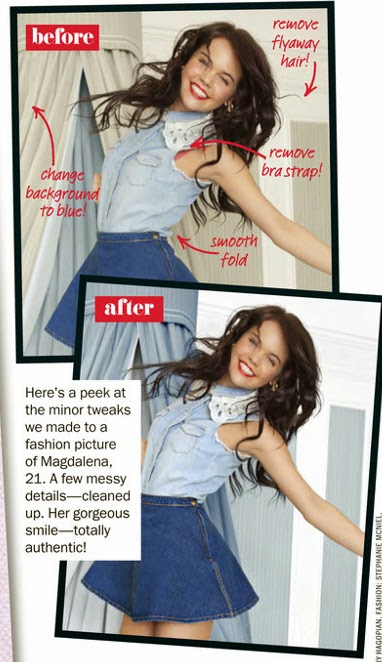
    Photo retouching makes it possible to beef up a man's physique or give a woman a wasp waist. The resulting images of models in magazines present impossible ideals for people. 


    The teen glamour magazine called Seventeen has made a pledge to its readers about how it will and won't digitally manipulate photos of young models.


    The magazine responded to an online petition by 14-year-old Julia Bluhm, who observed that many girls in her ballet class complained that they were fat.

    Seventeen's pledge to its readers says that it will never change a girl's body or face shape, and will change only incidental details, like "flyaway hair," a confusing background, or an out-of-place bra strap. They set up a special blog that takes readers behind the scenes at photo shoots and shows the images before and after retouching.

    The magazine "Glamour" has also responded to criticism, polling its readers about what how much retouching is good, and they produced a video where women answer the question "What makes you feel good about your body?"


    Here are some images of celebrities before and after Photoshop treatment:


    Adobe Photoshop CS6

    Below is a link to a guide to the toolbox in Photoshop:


    Photoshop Tutorial 1:

    Toolbox

    Magic Wand Tool

    Eyedropper

    Blur Tool

    Clone Stamp Tool

    Task 1: Open the images below in PS and manipulate the images to conform with feminine/ masculine ideals

    These images can also be found in Student share/Media/X_images


    Save the manipulated images in your home area.

    Have a look through this celebrity photoshop website make notes and discuss

    Monday, 15 December 2014

    Rep of Youth - Kes

    If you are carrying out a research investigation dealing with the representation of youth you will need to consider how young people are represented in the press.

    Here are some articles which can be used as a starting point:

    Why the young get a bad press
    http://www.theguardian.com/commentisfree/2010/sep/02/youth-bad-news-stories/print

    Riots were like 'a rave' and a chance for young people to get 'free stuff'
    http://www.dailymail.co.uk/news/article-2057492/England-riots-2011-chance-young-people-free-stuff.html

    They don't live for work ... they work to live
    http://www.theguardian.com/money/2008/may/25/workandcareers.worklifebalance


    Key questions to consider when you are researching Youth representation in news articles:

    Do the values and ideologies of the news institution have an impact on the way that youth are being represented?

    Are there any comments attached to the article that challenge or reinforce the main message behind the article?

    Are young people interviewed or quoted at any point during the article or are they marginalised completely from the article?

    All of these factors are extremely important and should structure the explanation part of your discussion of the article.

    In this clip of Ken Loach's film Kes Young people are shown to have strong family values which is the reason for the fight between Casper and McDowell.
    Casper is weary, he works very hard but has low aspirations for life after school.
    You should apply Marxism here and give consideration to the coal mines hwere the majority of Yorkshiremen earned a living prior to the Thatcher administration.


    Consider apllying further theory such as Maslow's hierarchy of needs.
    You also need to discuss Stuart Hall's reception theory.
    Who are the preferred, negotiated and oppositional readers?
    How do they decode the messages within Kes?

    Older readers who choose to to read negative stories about young individuals receive a small boost to their self esteem as a result. Why do you think this is?


    Sunday, 14 December 2014

    Rep of men. RotFS

    Learning objective: Watch the film 'Rise of the Footsoldier and apply media studies theory using Media Studies terminology.

    Areas to consider:
    • Can football hooligans be associated with Cohen's theory of Moral Panic? Consider the introduction of CCTV in and around football grounds and subsequently City centres and schools.
    • Consider ideology and a Marxist perspective when discussing the character Tony Tucker. His treatment and the reaction of the (young male character with long hair).
    • Who are the Preferred/dominat readers. The negotiated readers. The oppositional readers.
    • How and why do they decode the text?

    Monday, 8 December 2014

    Catch Up Session.

    As indicated on the checklist handout. All tasks need to be submitted for marking.
    If you have digital copies of these can you please e-mail them to Mr Ealey.
    aealey@de-la-salle.co.uk


    If you have submitted all of these then continue with research investigations.